Building an HTTP Server in Assembly: Learning the Foundations of Computing from Scratch
How Writing an x86_64 Server Forced Me to Confront Every Layer of the System
Introduction
When I decided to write a fully functional HTTP server in pure x86_64 Assembly for Linux, I thought I was signing up for a coding challenge. What I didn’t expect was the mind-expanding journey into the very foundations of computing. ASM Server isn’t just a server—it’s a project that forced me to re-learn everything I take for granted in programming.
Most developers rely on high-level languages and libraries to handle everything from string concatenation to network connections. In Assembly, there are no libraries, no helpers—just you, the CPU, memory, and the operating system. Every single piece of functionality had to be built by hand: converting numbers to strings, comparing strings, concatenating text, parsing HTTP requests, encoding responses, managing buffers, and even talking directly to the OS through system calls.
ASM Server in a Nutshell
ASM Server is a lightweight HTTP server capable of:
Serving static files with proper MIME types
Handling concurrent connections through process forking
Logging everything with a detailed logging system
Graceful shutdown on SIGINT (Ctrl+C)
Configurable behavior through
server.conf
It supports HTML, CSS, JS, images, SVGs, and even ICO files. Every feature, from file serving to error pages, is implemented directly in Assembly.
The Beauty of Basic Building Blocks
Encoding and Data Conversion
One of the first lessons Assembly taught me: nothing is automatic. Want to turn a number into a string to include in a log message? You have to write the code for it. Want to parse a string from the HTTP request and convert it to an integer? Also on you.
I built:
Functions to convert numbers to strings and back
String concatenation routines
String comparison utilities
Functions to validate and sanitize input
Every tiny operation that high-level languages do automatically had to be implemented from scratch. It’s amazing how much we rely on these “basic” operations without thinking about them.
Talking Directly to the OS
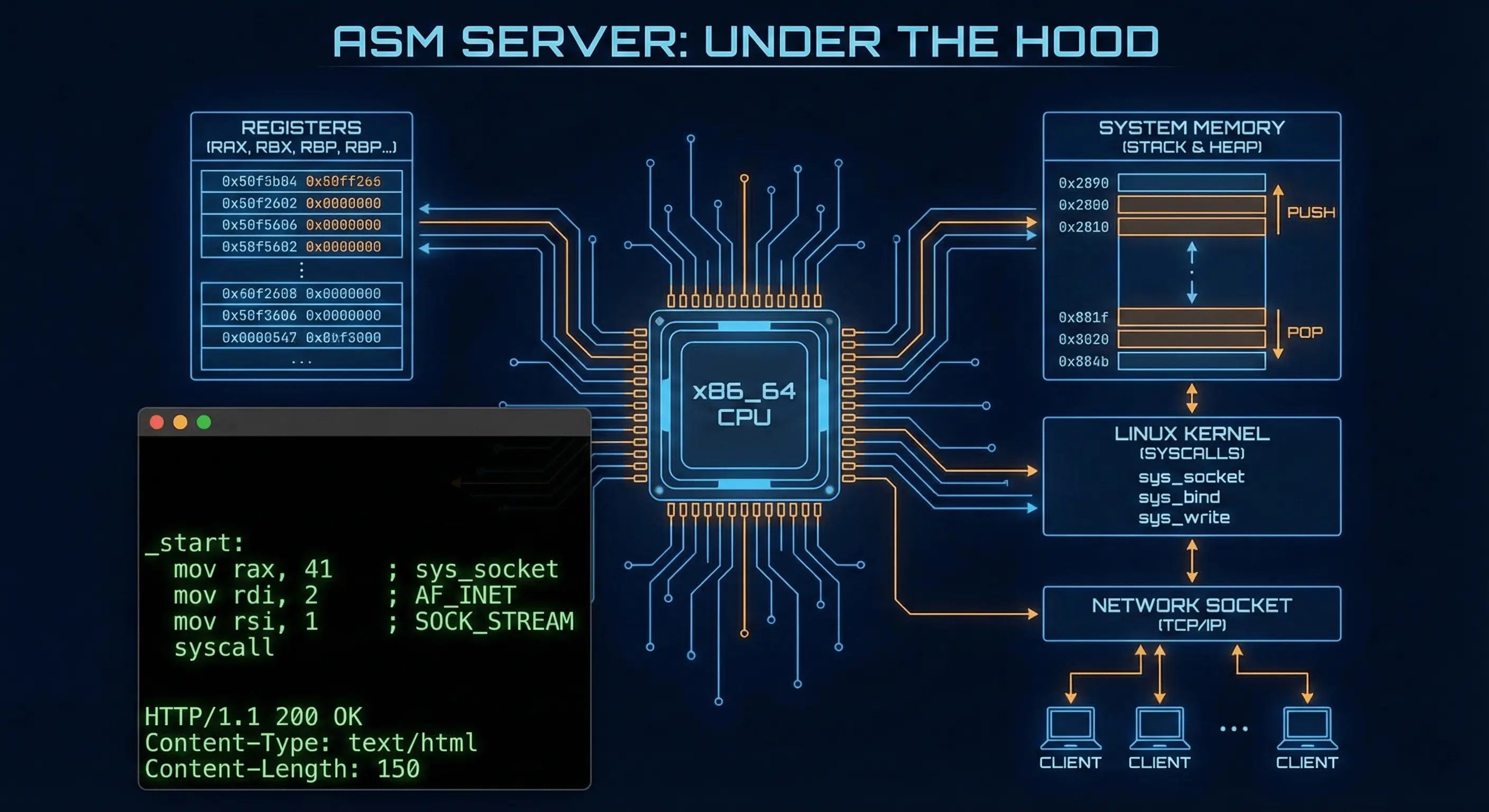
ASM Server taught me how to interact with Linux at its core. Every socket, read, write, and fork is a system call. That means providing the correct parameters in registers, handling return values, and managing the side effects yourself.
For example:
Creating a TCP socket: I had to manually set AF_INET, SOCK_STREAM, and the protocol number, then store the file descriptor in a register.
Binding and listening: Every byte of the address structure, every parameter for the syscall had to be carefully set.
Forking processes: Handling child and parent execution paths, closing connections correctly, and preventing leaks—all by hand.
System calls make you appreciate how much high-level frameworks automate for us, and how fragile things can be if you get even a single register wrong.
Challenges That Became Lessons
Some of the biggest headaches turned into the most valuable lessons:
Stack Alignment & Register Management Misaligned stacks or clobbered registers caused segmentation faults. Learning which registers are volatile and which must be preserved taught me the true meaning of calling conventions.
Buffer Overflows Concatenating strings or reading data could easily overflow a buffer. Every boundary had to be checked manually, or the server would crash.
Error Handling Without Libraries Logging errors without introducing more errors? That required creating separate, minimal routines that could safely write timestamps, error codes, and messages directly via syscalls.
Encoding Edge Cases Handling HTTP headers and file paths meant validating every character, preventing directory traversal, and converting raw bytes to readable text. It made me realize how much high-level languages shield us from subtle bugs.
Why This Was Worth It
ASM Server isn’t just a project—it’s a deep-dive into the machinery of computing. I had to reinvent everything I usually take for granted: strings, numbers, memory, network connections, concurrency, logging, configuration, and error handling.
By building these tools myself, I now understand why modern programming languages behave the way they do, and I have a much deeper appreciation for the abstractions that make development efficient and reliable.
Final Thoughts
Working with Assembly changed how I see every line of code I write. It’s not just about making things work—it’s about understanding why they work. Every syscall, every byte in memory, every register now tells a story.
ASM Server reminded me that the beauty of computer science isn’t just in writing applications—it’s in understanding the machinery underneath, one byte at a time.